Problem
Given two integer arrays nums1 and nums2, return an array of their intersection. Each element in the result must appear as many times as it shows in both arrays and you may return the result in any order.
Example 1:
Input: nums1 = [1,2,2,1], nums2 = [2,2]
Output: [2,2]
Example 2:
Input: nums1 = [4,9,5], nums2 = [9,4,9,8,4]
Output: [4,9]
Explanation: [9,4] is also accepted.
Constraints:
1 <= nums1.length, nums2.length <= 10000 <= nums1[i], nums2[i] <= 1000
Follow-up:
- What if the given array is already sorted? How would you optimize your algorithm?
- What if
nums1’s size is small compared tonums2’s size? Which algorithm is better? - What if elements of
nums2are stored on disk, and the memory is limited such that you cannot load all elements into the memory at once?
Approach & Explanation
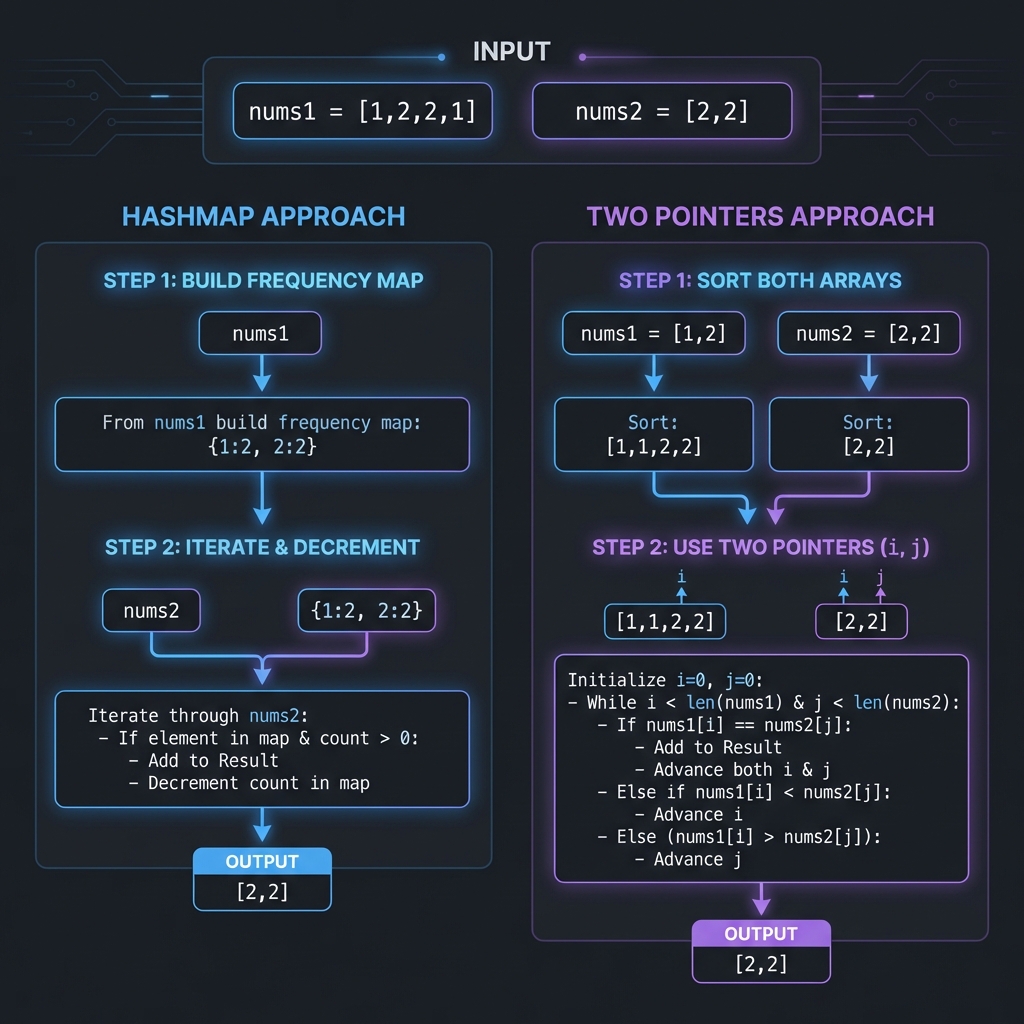
There are two main approaches to solve this problem:
Approach 1: HashMap (Frequency Count)
- Swap arrays so
nums1is always the larger array (for in-place result storage) - Build a frequency map from
nums1 - Iterate through the smaller array (
nums2) - If element exists in map with count > 0, add to result and decrement count
Note: Some implementations build the map from the smaller array for space optimization. This implementation builds from the larger array to allow reusing
nums1for the output.
Complexity:
- Time: O(m + n)
- Space: O(max(m, n)) for the hashmap
Approach 2: Two Pointers (Sorted Arrays)
- Sort both arrays
- Use two pointers, one for each array
- If elements are equal, add to result and advance both pointers
- Otherwise, advance the pointer with the smaller element
Complexity:
- Time: O(m log m + n log n) due to sorting
- Space: O(1) if we ignore the output array
When to Use Which?
| Scenario | Best Approach |
|---|---|
| Arrays already sorted | Two Pointers |
| One array much smaller | HashMap (on smaller array) |
| Memory limited | Two Pointers (external sort) |
| General case | HashMap |
Solution
Approach 1: HashMap
Java
import java.util.Map;
import java.util.HashMap;
import java.util.Arrays;

class Solution {
    public int[] intersect(int[] nums1, int[] nums2) {
        if(nums1.length < nums2.length) {
            return intersect(nums2, nums1);
        }
        Map<Integer, Integer> count = new HashMap<>();

        for (int num : nums1) {
            count.merge(num, 1, Integer::sum);
        }
        int k = 0;
        for(int num : nums2) {
            int cnt = count.getOrDefault(num, 0);
            if(cnt > 0) {
                nums1[k++] = num;
                count.merge(num, -1, Integer::sum);
            }
        }

        return Arrays.copyOfRange(nums1, 0, k);
    }
}
Go
func intersect(nums1 []int, nums2 []int) []int {
    if len(nums1) < len(nums2) {
        return intersect(nums2, nums1)
    }

    count := make(map[int]int)

    for _, num := range nums1 {
        count[num]++
    }

    k := 0

    for _, num := range nums2 {
        if count[num] > 0 {
            count[num]--
            nums1[k] = num
            k++
        }
    }

    return nums1[:k]
}
Approach 2: Two Pointers
Java
import java.util.Arrays;

class Solution {
    public int[] intersect(int[] nums1, int[] nums2) {
        Arrays.sort(nums1);
        Arrays.sort(nums2);

        int i = 0, j = 0, k = 0;
        while(i < nums1.length && j < nums2.length) {
            if(nums1[i] == nums2[j]) {
                nums1[k++] = nums1[i];
                i++;
                j++;
            } else if (nums1[i] < nums2[j]) {
                i++;
            } else {
                j++;
            }
        }

        return Arrays.copyOfRange(nums1, 0, k);
    }
}
Go
import "sort"

func intersect(nums1 []int, nums2 []int) []int {
    sort.Ints(nums1)
    sort.Ints(nums2)

    var intersection []int

    for i, j := 0, 0; i < len(nums1) && j < len(nums2); {
        if nums1[i] == nums2[j] {
            intersection = append(intersection, nums1[i])
            i++
            j++
        } else if nums1[i] < nums2[j] {
            i++
        } else {
            j++
        }
    }

    return intersection
}
Key Insight
The HashMap approach is generally preferred because it has better time complexity (O(m+n) vs O(m log m + n log n)). However, if the arrays are already sorted or if memory is extremely limited, the Two Pointers approach becomes more efficient.